Sixth planet · 9.5 au from the Sun
Saturn
Nine times as wide as Earth and so light for its size that it would float, given a big enough bath. Fall towards it and the rings stop being a picture and become a roof.
Wide and very thin
The bright rings stretch about 270,000 km from edge to edge, two-thirds of the way from Earth to the Moon. Most of them are only around ten metres thick. Scale them down to the width of a football pitch and they would be far thinner than a sheet of paper.
They are almost all water ice, in pieces from grains of dust up to lumps the size of a house, each one going round Saturn on its own orbit.
Squashed by its own spin
A day on Saturn lasts about ten and a half hours. Spinning that fast, a planet made mostly of hydrogen and helium bulges at the middle. It is about a tenth wider at the equator than from pole to pole, enough to see by eye in a photograph.
The gaps in the rings are real gaps. The widest, the Cassini Division, is about 4,500 km across and is kept fairly clear by the pull of the moon Mimas.
Under the rings
From the cloud tops at 40° north, the rings are a bright arch from one side of the sky to the other. It is northern summer here, so the Sun lights the side of the rings you are looking at. The dark band between the two bright ones is the Cassini Division.
The light is weak. Saturn is nearly ten times as far from the Sun as we are, so a summer afternoon here gets about a hundredth of the sunlight of one at home.
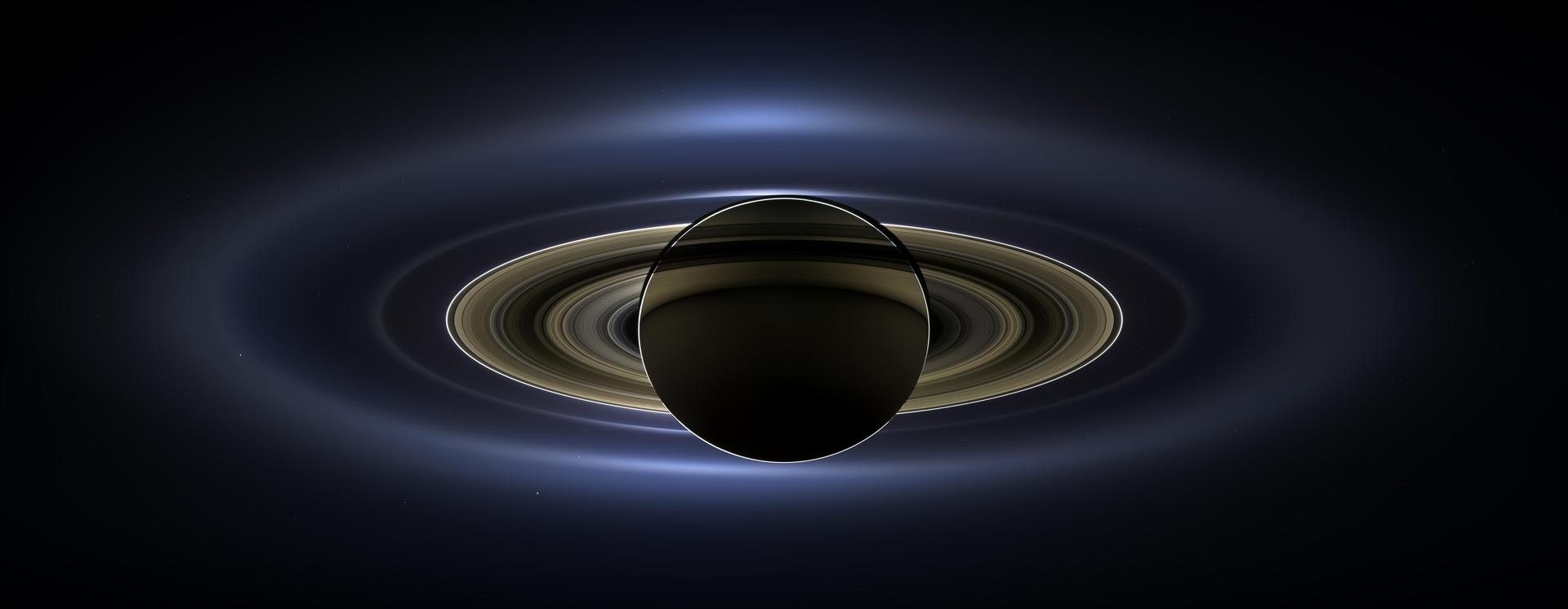
The day the Earth smiled
On 19 July 2013 Cassini passed into Saturn’s shadow and looked back towards the Sun. With the planet blocking the glare, the faint outer rings lit up, and so did a small pale dot below them: Earth, about 1.4 billion km away. People had been told in advance and went outside to wave.
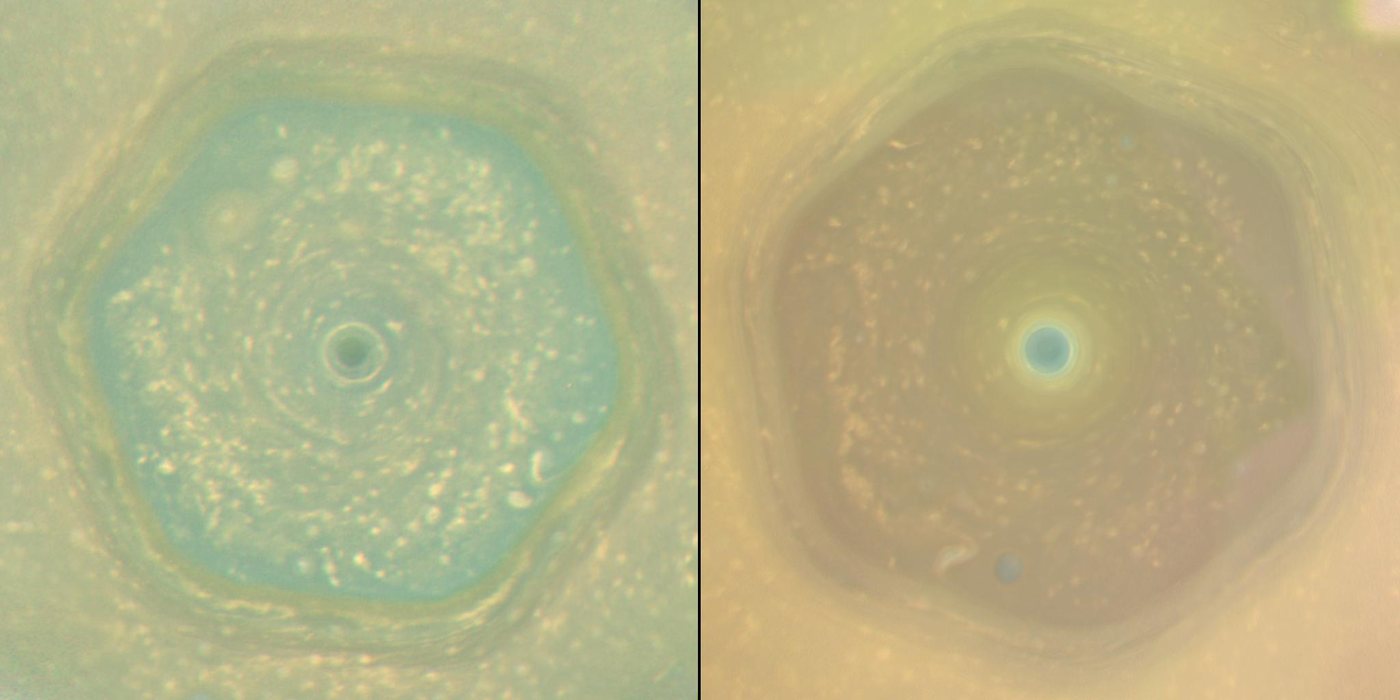
A six-sided storm
Around the north pole a jet stream runs in a hexagon about 29,000 km across, more than twice the width of Earth. It has been there since Voyager first photographed it in 1981, and nobody has seen anything quite like it elsewhere. As summer came on, its colour changed from blue to gold.
In numbers
- Radius at the equator
- 60,268 km
- Radius at the poles
- 54,364 km
- Mass
- 568.32 × 10²⁴ kg
- Average density
- 687 kg/m³
- Distance from the Sun
- 9.537 au
- A year
- 29.4 years
- A day
- 10 h 33 min
- Axial tilt
- 26.73°
- Known moons (NASA)
- 274
NASA NSSDC Saturn Fact Sheet and JPL orbital elements. Ring edges from the NASA Saturnian Rings Fact Sheet. Cassini orbited Saturn from 2004 until 15 September 2017, when it was steered into the planet. In 2025 the rings were edge-on to Earth and almost vanished in small telescopes.
The clouds here are generated. The rings in the sky are worked out from the real ring edges and Saturn’s real shape, for 40° north on a late summer afternoon.