Fifth planet · 5.2 au from the Sun
Jupiter
Two and a half times heavier than everything else that orbits the Sun, put together. There is no ground to land on, so this time you will fall into the sky.
Four moons, found in 1610
Galileo pointed a telescope at Jupiter and saw four small lights that changed place from night to night. They were moons going round it, the first proof that not everything in the sky goes round Earth.
Io is the most volcanic place we know. Europa hides an ocean under its ice. Ganymede is the biggest moon in the solar system, bigger than Mercury. Callisto is old and cratered.
Their orbits are to scale. Their sizes are not.
Nothing to land on
Jupiter is almost all hydrogen and helium. The deeper you go, the thicker the gas gets, until it is hard to say where gas ends and liquid begins. There is no moment of touching down.
Far below the clouds, the pressure turns hydrogen into something like a liquid metal. Its swirling is thought to make Jupiter’s magnetic field, the strongest of any planet.
Belts, zones and lightning
The light stripes are zones where gas rises. The dark ones are belts where it sinks. Neighbouring stripes blow in opposite directions at up to 150 metres a second, which is about 540 km/h.
Lightning is real here. Voyager 1 saw flashes in 1979, and Juno has recorded them since, mostly near the poles.
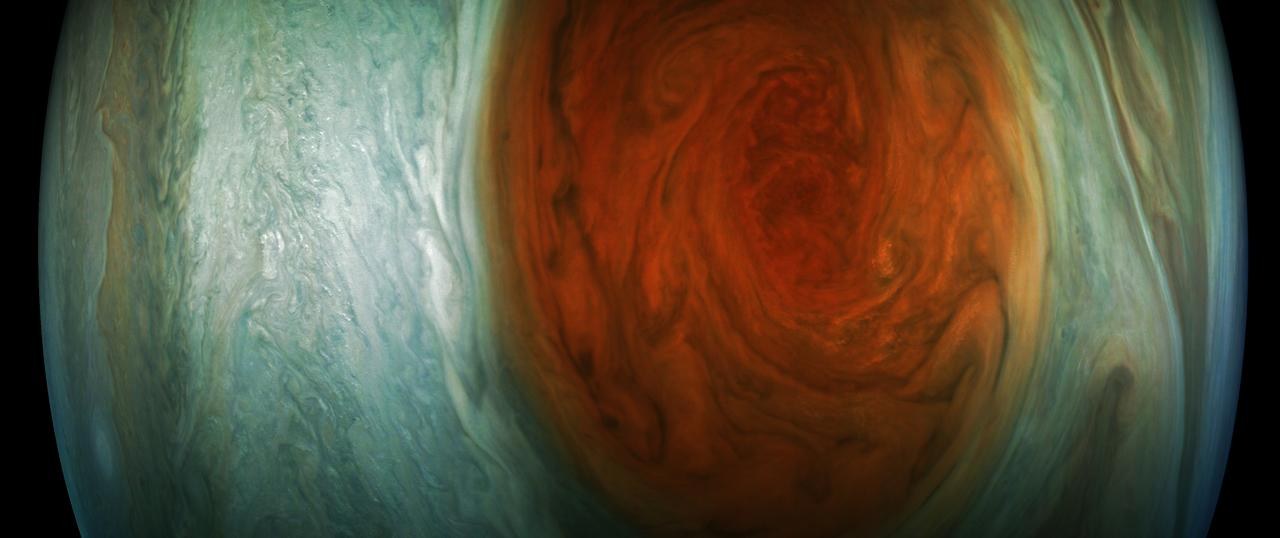
The clouds here are generated. You are over the northern edge of the Great Red Spot, with its pale rim ahead. The small moon is Io, drawn at its true size: about as big as our Moon looks from Earth. Pressure is counted in bars, and one bar is the air pressure at sea level on Earth.
The storm
The Great Red Spot is a storm now about one and a third times as wide as Earth. People have watched it for well over a century, and it has been shrinking for most of that time.
Nobody is sure why it is red. The colour comes from something deep that gets carried up and bleached or reddened by sunlight.
In numbers
- Radius at the equator
- 71,492 km
- Mass
- 1,898 × 10²⁴ kg
- Gravity at the cloud tops
- 25.92 m/s²
- Distance from the Sun
- 5.203 au
- A year
- 11.9 years
- A day
- 9.93 hours
- Temperature at 1 bar
- −108 °C
- Known moons (NASA)
- 95
NASA NSSDC Jupiter Fact Sheet and JPL orbital elements. Moon counts change as new moons are confirmed. Juno has been orbiting since 2016.